How the YouTube Algorithm Actually Works: The Complete Creator Playbook
Stop guessing how the YouTube algorithm works. Learn how YouTube tests, ranks, and pushes videos with real retention and CTR benchmarks.
Stop Guessing the Algorithm: How YouTube Actually Recommends Videos
Almost every creator asks the same frustration-filled questions at some point in their YouTube journey: "Why did my video suddenly stop getting views after 50 impressions?" or "Why is YouTube refusing to push my content to a wider audience?"
Most beginners treat the YouTube algorithm like a mysterious lottery machine or an unyielding robot that demands secret tags, exact upload timestamps, or hidden SEO hacks. They obsess over metadata while ignoring the foundational reality of modern digital platforms.
The truth is much simpler and far more empowering: The YouTube algorithm does not watch or evaluate your video—it watches and evaluates the audience.
YouTube operates on a clear, single business objective: to maximize viewer satisfaction and keep users engaged on the platform for as long as possible. When you create content that viewers click on, enjoy, and watch through to completion, YouTube's multi-layered recommendation engine naturally does the heavy lifting for your channel growth.
This comprehensive guide breaks down how YouTube evaluates your content behind the scenes, explores the 6-stage testing lifecycle, breaks down critical benchmark metrics in detailed comparison tables, and gives you actionable AI prompt frameworks to trigger positive algorithmic feedback loops.
The Core Philosophy: Following the Audience, Not the Code
YouTube's recommendation architecture relies on sophisticated deep neural networks divided into two primary operational pipelines:
- Candidate Generation (Filtering): The system sifts through hundreds of millions of uploaded videos across the platform to generate a tailored pool of candidate videos for each user. This pool is built directly from the individual user's watch history, search queries, channel affinities, and co-watch habits.
- Ranking: Once a candidate pool is assembled, the neural network scores each video in real-time. It evaluates complex engagement signals—such as historical click-through rates, average watch time, recent survey scores, and audience retention curves—to construct a custom ranked feed on the viewer's Homepage, Search results, or Suggested Video sidebar.
If a user clicks on a thumbnail but leaves within 10 seconds, YouTube registers a clear negative signal: the video failed to fulfill its promise for that specific viewer demographic. Conversely, if a viewer watches 70% of a video and proceeds to watch a second video on your channel, YouTube awards your video maximum distribution leverage.
The 6-Step Recommendation Lifecycle
Whenever you publish a new video, YouTube does not immediately deploy it to millions of feeds. Instead, the engine processes every upload through a controlled, 6-stage algorithmic test:
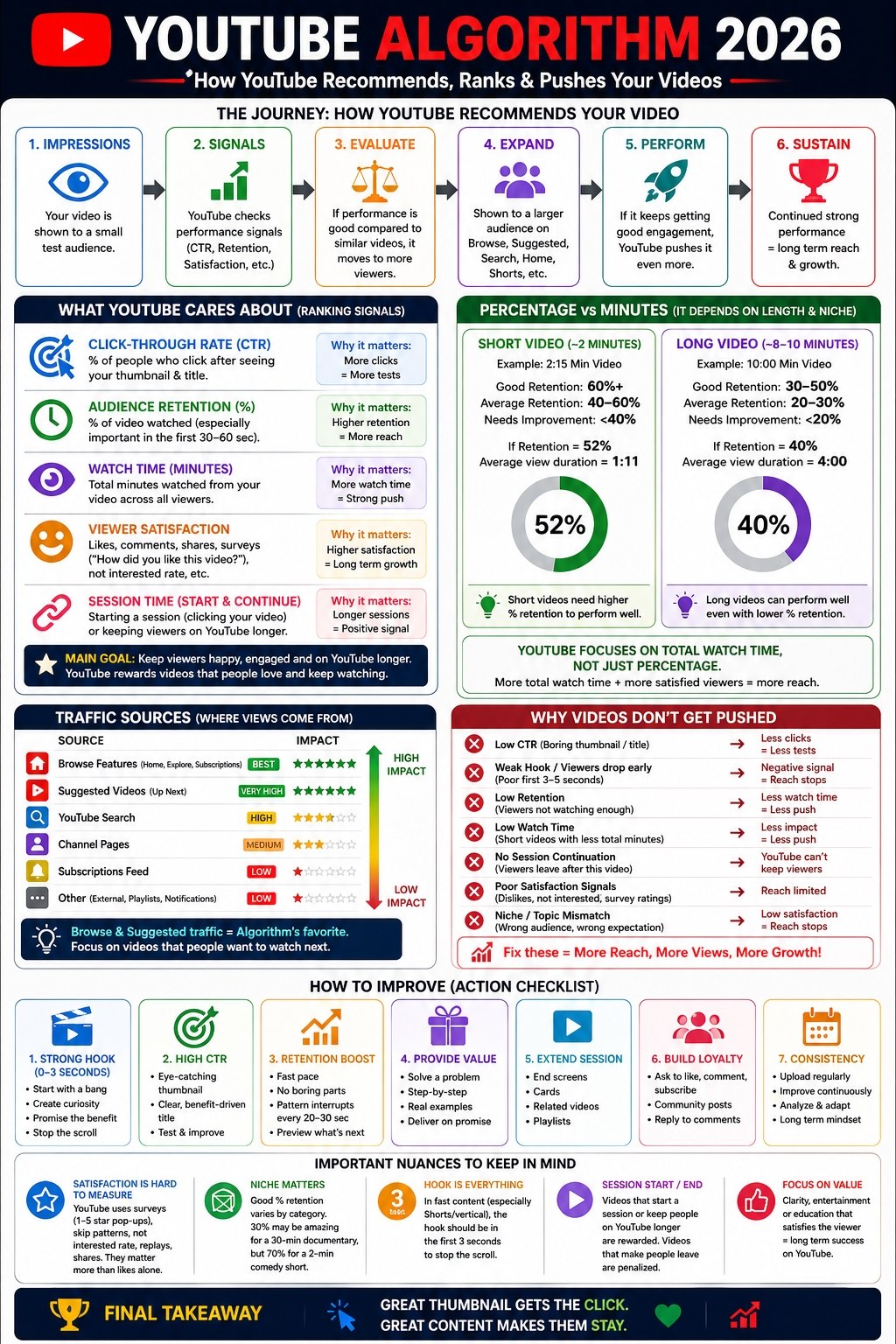
Step 1: Subscriber & Core Seed Audience Testing
Immediately upon publishing, YouTube serves your thumbnail to your most loyal subscribers via notification feeds, subscription tabs, and initial homepage impressions. The Click-Through Rate (CTR) and initial retention metrics established by this core group establish your performance baseline.
Step 2: Niche & Relevant Topic Match
If your seed audience responds with above-average engagement, YouTube broadens distribution. It targets non-subscribers who frequently watch similar topics, niche competitors, or specific keyword clusters related to your video's core subject.
Step 3: Broad Audience Testing
Should your CTR and Average View Duration (AVD) remain strong, the system tests your video with adjacent interest groups—viewers who enjoy general niche topics but may not be familiar with your channel brand yet.
Step 4: Real-time Metric Assessment
During broad testing, YouTube actively monitors whether CTR and retention suffer a severe drop-off. If your CTR drops precipitously from 10% to under 2%, distribution throttles back while YouTube re-evaluates which specific audience sub-segments respond best.
Step 5: Homepage & Suggested Video Surging
When a video successfully holds solid retention across broader demographics, the algorithm triggers viral or broad distribution. It places the content prominently on primary YouTube Homepages and top Suggested Video sidebars worldwide.
Step 6: Evergreen Search & Discovery Indexing
Once the initial recommendation surge normalizes, YouTube indexes the video into long-term Search, Recommendation, and Browse clusters. A well-optimized video will continue to harvest steady passive views for months or even years.
Key Algorithmic Metrics & Performance Benchmarks
To optimize your content scientifically, you need to understand the quantitative benchmarks YouTube's ranking algorithms look for. The chart below outlines key metrics across different video lengths and audience tiers:
| Metric | Target Benchmark (Niche/Core) | Viral Benchmark (Broad Audience) | Algorithmic Impact | Primary Optimization Focus |
|---|---|---|---|---|
| Click-Through Rate (CTR) | 4% - 7% | 8% - 12%+ | High (Initial Hook) | Thumbnails, Titles, Packaging |
| Average Percentage Viewed (APV) | 40% - 50% | 60% - 70%+ | Critical (Retention Signal) | Intro Hook, Pacing, Content Structure |
| Average View Duration (AVD) | 4 - 6 mins (10 min video) | 7 - 9+ mins (10 min video) | Critical (Watch Time) | Storytelling, Open Loops, Value Density |
| Session Duration / Binge Rate | 1.2 Views/Viewer | 2.5+ Views/Viewer | Very High (Platform Loyalty) | Playlists, End Screens, Cards |
| Viewer Satisfaction Score | 4.0 / 5.0 Rating | 4.8 / 5.0 Rating | High (Qualitative Filter) | Value Delivery, Honest Packaging |
Deep Dive: The Metrics That Dictate Distribution
1. Click-Through Rate (CTR)
CTR measures the percentage of viewers who click your thumbnail after seeing it on their feed. High CTR signals that your title and thumbnail combination creates effective curiosity and emotional resonance.
2. Retention Curves & Average Percentage Viewed (APV)
Getting the click is only half the battle. If viewers leave during the first 30 seconds, YouTube classifies the title as clickbait. Your objective is to eliminate fluff and maintain a flat retention line through constant value delivery and visual hooks.
3. Session Watch Time & Binge Behavior
YouTube prioritizes creators who extend total user session time. If your video serves as the starting point for a 45-minute YouTube binge, your channel receives elevated algorithmic authority across all published content.
4. Qualitative Satisfaction Surveys
YouTube periodically asks viewers: "How was this video?" with 1-to-5 star options. Videos that deliver genuinely satisfying content receive long-term distribution advantages over clickbait channels with high bounce rates.
Interactive Key Takeaways & FAQ
Key Takeaways
- Audience First: The algorithm responds entirely to viewer habits, satisfaction, and watch patterns.
- Master the First 30 Seconds: Secure high retention by delivering immediately on your thumbnail's promise.
- Drive Binge Sessions: Use end screens, cards, and topic playlists to keep viewers watching your channel.
- Analyze Benchmarks: Target a 6%+ CTR and 50%+ APV to unlock broader algorithmic reach.
Frequently Asked Questions (FAQ)
Q1: Does changing my video title or thumbnail reset algorithmic recommendations?
No! Changing your title or thumbnail gives YouTube new data. If an underperforming video gets a refreshed, higher-CTR thumbnail, YouTube will test it again with fresh impressions.
Q2: Do upload frequency and upload time affect the algorithm?
Upload time only affects initial immediate views from subscribers. Long-term distribution depends entirely on retention, CTR, and audience demand—not the exact hour you hit publish.
Q3: Do video tags still matter for YouTube SEO?
Tags play a minor role today. YouTube primarily analyzes transcript audio, title keywords, thumbnail context, and viewer co-watching behavior to categorize content.
Conclusion
Stop trying to hack the YouTube algorithm with superficial tricks or outdated SEO tactics. Focus your energy on understanding human psychology, sharpening your packaging, and engineering high-retention video structures. When you serve the viewer, the algorithm naturally serves you.